Our (IN)VISIBLE Report exploring the impact of sex and gender on health experiences and outcomes in Scotland has been published!
This 48-page report pulls together evidence and insight from 50+ VHS members and wider stakeholders, as well as national and academic sources, to identify key themes on the relationship between sex, gender and health. From the evidence gathered, the report identifies broad themes regarding the causes of gender-related health inequalities as well as providing six recommendations for future action.
(IN)VISIBLE Report Launch Event:
The report was launched at an online event on the 19th May 2026. Following a presentation summarising the findings from VHS Policy and Public Affairs Lead, Sarah Latto, three VHS members who contributed to the research joined a panel discussion. Audience members were then invited to participate in a live Q&A. If you weren’t able to join us on the day, we have a recording of the presentation and panel discussion. If you would like to watch it, please get in touch for the link. Alternatively, you can read the Key Messages.
Downloads
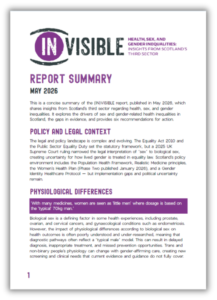
Full (IN)VISIBLE Report (IN)VISIBLE Report Summary
A Microsoft Word version of the report is also available. Please contact us to request a copy.
About the Report
The purpose of the (IN)VISIBLE research is to utilise third sector evidence and insight to identify broad themes in how sex and gender impact on health outcomes and experiences. As well as increasing our understanding of sex and gender related health inequalities, this report also showcases the third sector as an important source of evidence and insight, particularly regarding health inequalities. The research was undertaken between November 2025 and March 2026. All VHS members and stakeholders were invited to participate through an anonymous survey, 2 workshops, and a series of 1-1 discussions. Some also chose to send written evidence or links to publications.
The report highlights a range of gendered health inequalities across Scotland including how gendered health inequalities are compounded further when an individual is older, has a disability, is LGBTQ+, or is from an ethnic minority group.
The report identifies six recommendations:
- Ensure that health policy reflects the totality of sex and gender-related health inequalities.
- Ensure that health research and data reflect the impact of sex and gender on health experiences and outcomes, including how sex and gender intersect with other protected characteristics.
- Ensure that the wider health workforce is required to undertake tailored training on the specific impact of sex and gender on health outcomes and experiences, in line with efforts to embed Realistic Medicine.
- Invest in dedicated systems, services and spaces that address common sex and gender-related barriers that contribute to ‘missingness’ in healthcare.
- Invest in campaigns to raise public awareness of the impact of sex and gender on health experiences and outcomes.
- Recognise the vital role of the third sector in understanding intersectional health inequalities, providing inclusive services and amplifying voices of lived experience.
Endorsements
Professor Andrea Williamson, a leading voice in health inequalities from the University of Glasgow, stated that:
‘This latest Voluntary Health Scotland report about health, sex and gender inequalities exemplifies the incisive, nuanced perspective our vital third sector brings to enrich health, healthcare and society in Scotland.’
Enquiries
Media Enquiries: Download Press Release
For all other enquiries, or to share ideas about increasing the reach of the report, please email sarah.latto@vhscotland.org.uk.